
Fall Embroidery Trends for Custom Apparel in 2026
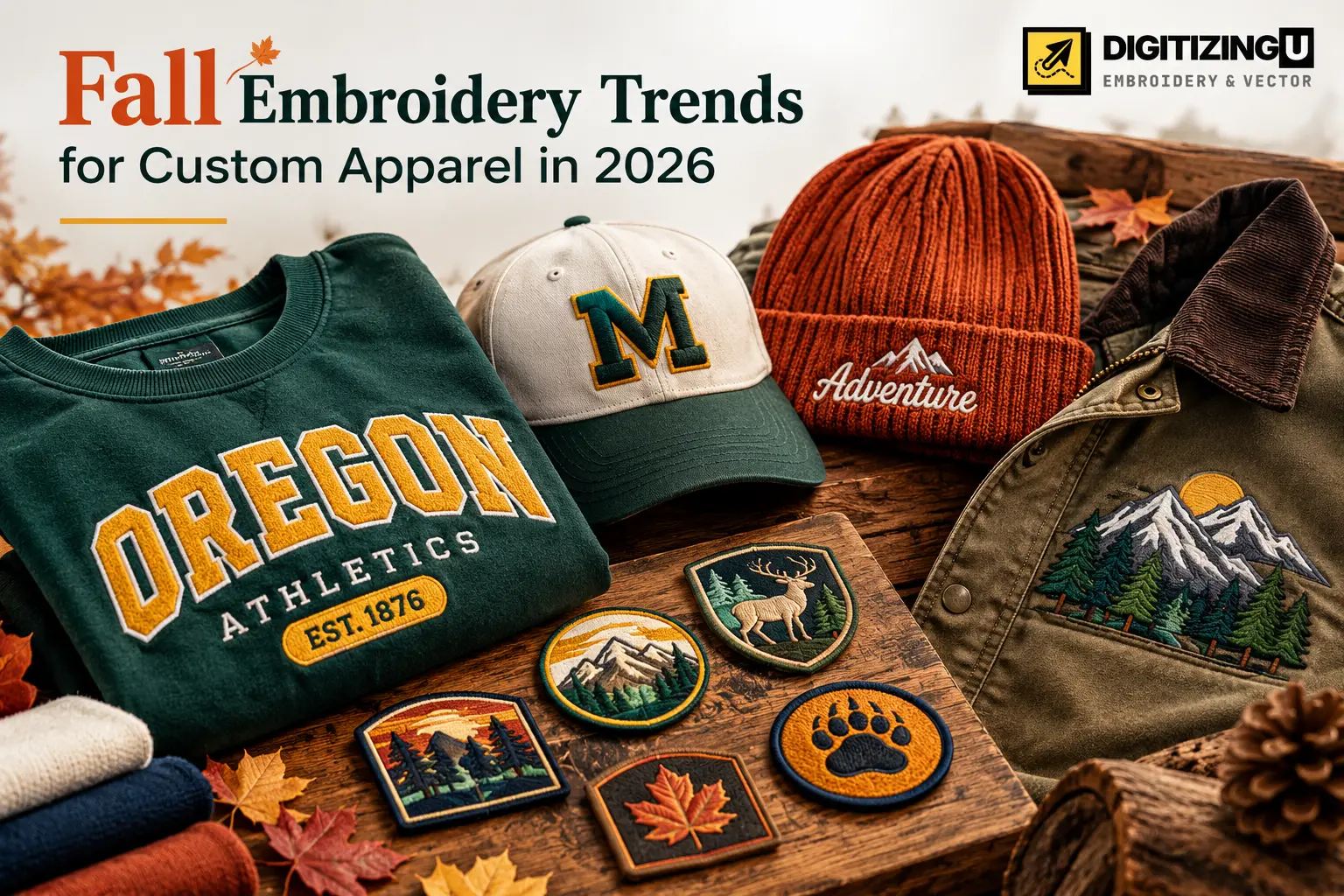
For commercial embroidery shops, contract decorators, custom apparel brands, and promotional product distributors across the United States, autumn represents the most profitable quarter of the operational year.
As temperatures decline, consumers and corporate clients trade lightweight summer tees and performance polos for heavyweight fleece hoodies, flannel work shirts, softshell jackets, ribbed knit beanies, canvas chore coats, and structured headwear.
At the same time, institutional and commercial demand surges across multiple high-volume sectors simultaneously:
- Fall High School & Collegiate Athletics: Football, cross-country, soccer, volleyball, cheer squads, and marching bands require warm-ups, sideline jackets, and spirit wear.
- Homecoming & Alumni Merchandise: Campus bookstores, fraternity/sorority chapters, and booster clubs order retro collegiate sweatshirts and premium varsity outerwear.
- Corporate & Executive Outerwear: Q4 corporate gifting, end-of-year employee milestones, and trade show season spark bulk orders for embroidered microfleece vests and weather-resistant technical jackets.
- Craft Breweries, Distilleries & Hospitality: Autumn seasonal beer releases, harvest festivals, and taproom apparel demand earth-toned beanies, chore jackets, and custom patches.
- Trade Contractors & Industrial Workwear: Construction outfits, HVAC technicians, landscapers, and logistics companies gear up with durable canvas outerwear and heavy-duty logo caps before winter storms arrive.
While autumn merchandise naturally includes the late-season Halloween rush, the commercial reality is that Fall 2026 embroidery demand is vastly broader, lasting continuously from late August through the holiday gifting rush.
Capturing higher profit margins on these orders requires more than offering standard flat left-chest logos. Apparel brands and commercial clients in 2026 demand elevated textural depth, vintage tactile aesthetics, nature-inspired palettes, and sophisticated mixed-media craftsmanship.
This comprehensive guide examines the dominant Fall 2026 embroidery trends across custom apparel and provides commercial embroidery shops with the technical digitizing strategies, stabilizer protocols, and machine calibration rules needed to sew these styles cleanly at production speeds.
What Is Trending in Fall Embroidery in 2026?
Commercial apparel in 2026 has decisively shifted away from flat, lifeless promotional branding toward premium tactile engagement and subtle sophistication. Buyers no longer want apparel that looks like a cheap trade-show freebie; they demand retail-level craftsmanship that commands premium price points ($65 to $120+ retail for custom outerwear and hoodies).
Industry trade shows, garment distributor catalogs (SanMar, S&S Activewear, AlphaBroder), and commercial decoration trends reveal eleven dominant movements defining Fall 2026:
- 1Textured and Dimensional Surfaces: Raised 3D puff, looped chenille textures, and heavy-gauge faux hand-stitch fills that beg to be touched.
- 2Vintage & Heritage Typography: Nostalgic 1970s and 1980s arched athletic block letters, cursive chain-stitch scripts, and distressed retro badge emblems.
- 3Collegiate Spirit Aesthetics: High-contrast tackle twill appliqué, split-front lettering, and arched two-color athletic layouts on heavyweight reverse-weave fleeces.
- 4Outdoor & Pacific Northwest Graphics: Mountain silhouettes, fir tree contours, retro camper badges, and trail map line art on rugged canvas and fleece vests.
- 5Nature Motifs & Wildlife: Finely digitized game birds, flora, pinecones, and botanical branches using directional feathering rather than solid blocks.
- 6Bold, Chunky Typographic Statements: Heavy slab-serifs and condensed athletic fonts digitized with crisp satin borders and subtle contour shading.
- 7Minimalist Micro-Logos: Tiny 1.25" to 1.75" minimalist tonal icons placed on hoodie wrists, back neck yokes, and beanie cuff folds.
- 8Layered & Mixed-Media Embellishments: Combining direct embroidery with screen printing, heat transfer vinyl, or laser-etched leather appliques.
- 9Premium Tonal & Monochromatic Palettes: Thread colors matched within one or two shades of the garment fabric (e.g., charcoal thread on black fleece, olive thread on military green jackets) for understated corporate luxury.
- 10Freestanding & Merrowed Patches: Custom twill, faux leather, and woven patches heat-pressed or stitched onto caps, chore jackets, and beanies.
- 11Matte & Heavyweight Threads: Transitioning from ultra-shiny trilobal polyester to low-sheen matte poly or thicker threads that mimic traditional spun cotton.
Only trends grounded in proven commercial apparel demand and viable mechanical production workflows provide sustainable shop profit. Below, we break down each major trend with actionable digitizing parameters.
Vintage and Retro Embroidery
The demand for retro nostalgia in 2026 is at an all-time high, particularly across streetwear labels, collegiate spirit lines, craft brewery workwear, and heritage corporate brands.
Consumers love the weathered, hand-crafted charm of 1970s outdoor clubs and 1990s collegiate athletics. However, achieving an authentic vintage aesthetic on modern high-speed multi-head machinery requires deliberate digitizing adaptations.
Key Design Elements of the Vintage Aesthetic
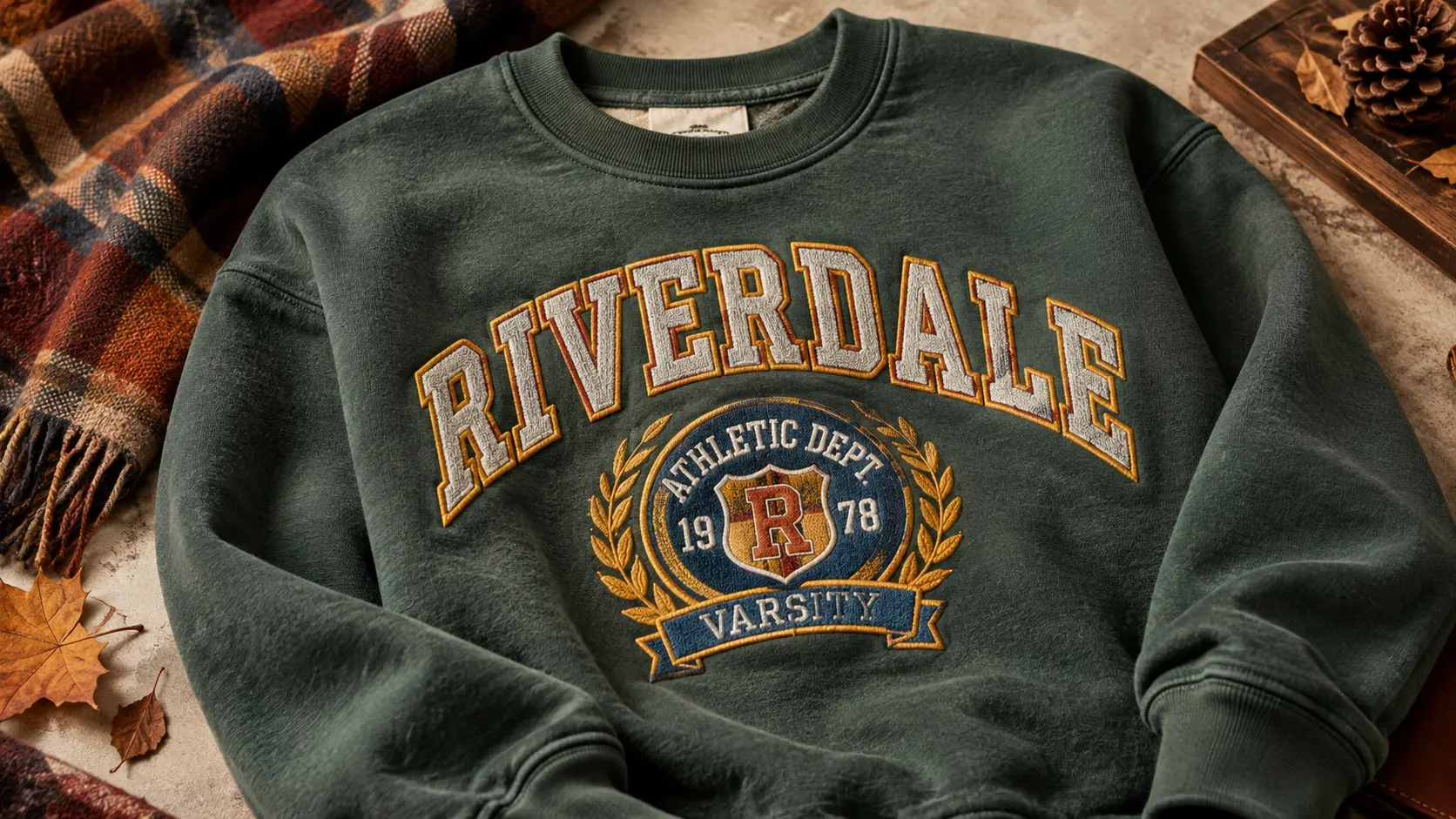
- Retro Athletic Typography: Arched block lettering with thick interior serifs, dropped shadows, and manual contour underlines.
- Faded & Muted Color Schemes: Replacing modern neon primaries with vintage cream, mustard, dusty brick red, faded denim blue, and warm ecru.
- Chain-Stitch and Cursive Script: Flowing monoline calligraphy that mimics mid-century chain-stitch chenille machines (popularized on mechanic jackets and bowling shirts).
- Emblematic Badge Layouts: Circular, hexagonal, or shield-shaped heraldic layouts featuring banner scrolls, established dates ("EST. 1984"), and hand-drawn stars.
- Open-Grid Shading: Simulating antique woodcut prints or copperplate etchings through parallel hatch runs and bean stitches rather than solid tatami blocks.
Digitizing Considerations for Vintage Effects
Achieving a genuine retro feel means resisting the urge to make every stitch ultra-flat and hyper-dense:
- Relaxed Density Settings: Modern standard digitizing defaults to 0.40mm stitch spacing. For a soft, broken-in vintage look, open tatami fill densities to 0.46mm – 0.52mm. This softens the embroidery, eliminates the stiff "bulletproof shield" feel, and allows the natural texture of French terry or canvas to subtly breathe through.
- Emulating Chain-Stitch with Satin Offsets: True chain-stitch machines are rare in contract shops. Digitizers can emulate chain-stitch script using narrow variable-width satin columns (1.2mm to 1.8mm width) with randomized edge points, or heavy triple-bean runs mapped in a figure-eight looping pattern.
- Underlay Selection: Instead of heavy, rigid double-tatami underlays, use open center-run underlays combined with a light edge-walk. This stabilizes the letter without stacking excess thread height beneath the vintage satin columns.
- Curved Stitch Angles (Flowing Pathing): Never digitize vintage script with uniform 90-degree cross-stitches. Map manual turning stitch angles along the natural bend of the calligraphy to reflect light dynamically, imitating vintage hand-guided embroidery.
If your client provides rough scanned sketches or low-resolution historical artwork, start with professional Vector Tracing to clean up anchor points before digitizing the stitch paths.
Collegiate, Athletic, and Spirit Wear Embroidery
Fall is synonymous with American school sports. From Friday night high school lights to Saturday collegiate tailgates and Sunday professional leagues, athletic apparel represents enormous production volume for commercial shops between August and November.
High-impact fall spirit wear focuses on heavyweight garments: 12 oz reverse-weave crewnecks, full-zip stadium jackets, sideline hoodies, and coach's caps.
Essential Techniques for Spirit Wear
- Tackle Twill Appliqué: The gold standard for varsity athletics. Large letters and mascots are laser-cut from poly-twill fabric and secured with precision zig-zag or satin border stitching. Learn more about our specialized Appliqué Digitizing workflows, and explore our focused breakdown of Football Embroidery Ideas for Custom Team Apparel.
- Split-Front Lettering: Baseball jerseys and full-zip hoodies featuring arched school names split across the zipper placket.
- 3D Puff Athletic Caps: Raised 3D foam lettering for school initials (e.g., "B", "STATE", "HC") on structured wool-blend snapbacks.
- Two-Color Arched Lettering: Inner satin fill surrounded by a contrasting outline satin border, engineered with exact mechanical overlap to eliminate registration gaps.
Digitizing Blueprints for High-Volume Spirit Wear
Professional tackle twill appliqué follows a rigid 4-stage machine execution:
- 1Running Stitch Run (Placement Guide): The needle sews a light single-run outline directly onto the garment to indicate where the pre-cut fabric piece must sit.
- 2Machine Stop / Frame Out: A programmed color stop (M00/Pause) pauses the machine and drives the pantograph outward, allowing the operator to spray adhesive and place the twill insert.
- 3Tack-Down Run: A quick zig-zag or e-stitch anchors the twill firmly to prevent edge shifting.
- 4Cover Satin Border: A wide 3.5mm to 4.5mm satin border encapsulates raw cut edges, sealing them completely against laundering wear.
Critical Digitizing Rules for Athletic Spirit Wear:
- Stitch Count Management on Oversized Designs: A full-front 11" collegiate design executed in solid tatami stitches can easily exceed 75,000 to 90,000 stitches—taking 75 minutes per garment to sew and turning the chest into an unwearable cardboard plate. By converting the center fill to tackle twill appliqué, the stitch count drops to 16,000–22,000 stitches. Production time is slashed by over 70%, and garment drape is preserved.
- Appliqué Cutline Calibration: When creating vector cutlines for laser cutters or vinyl plotters, digitizers must include a 0.8mm to 1.2mm inward offset. This ensures the cover satin stitch fully encapsulates the twill border without raw edge fraying during washing.
- Split-Front Placket Alignment: On zippered garments, the left and right halves must be digitized with a 2.0mm safety buffer back from the zipper teeth. Stitch direction should run away from the zipper placket toward the armholes to avoid dragging fabric toward the metal teeth.
- Combating Fleece Stretch on Heavy Hoodies: Athletic fleece stretches both horizontally and vertically. Always program a dense foundation underlay grid (double perpendicular run) to anchor the knit loops to the cutaway backing before laying down satin borders.
Outdoor, Nature, and Earth-Tone Embroidery
The outdoor lifestyle sector—encompassing hiking brands, ski resorts, Pacific Northwest apparel, hunting apparel, craft breweries, and rugged workwear—dominates fall retail.
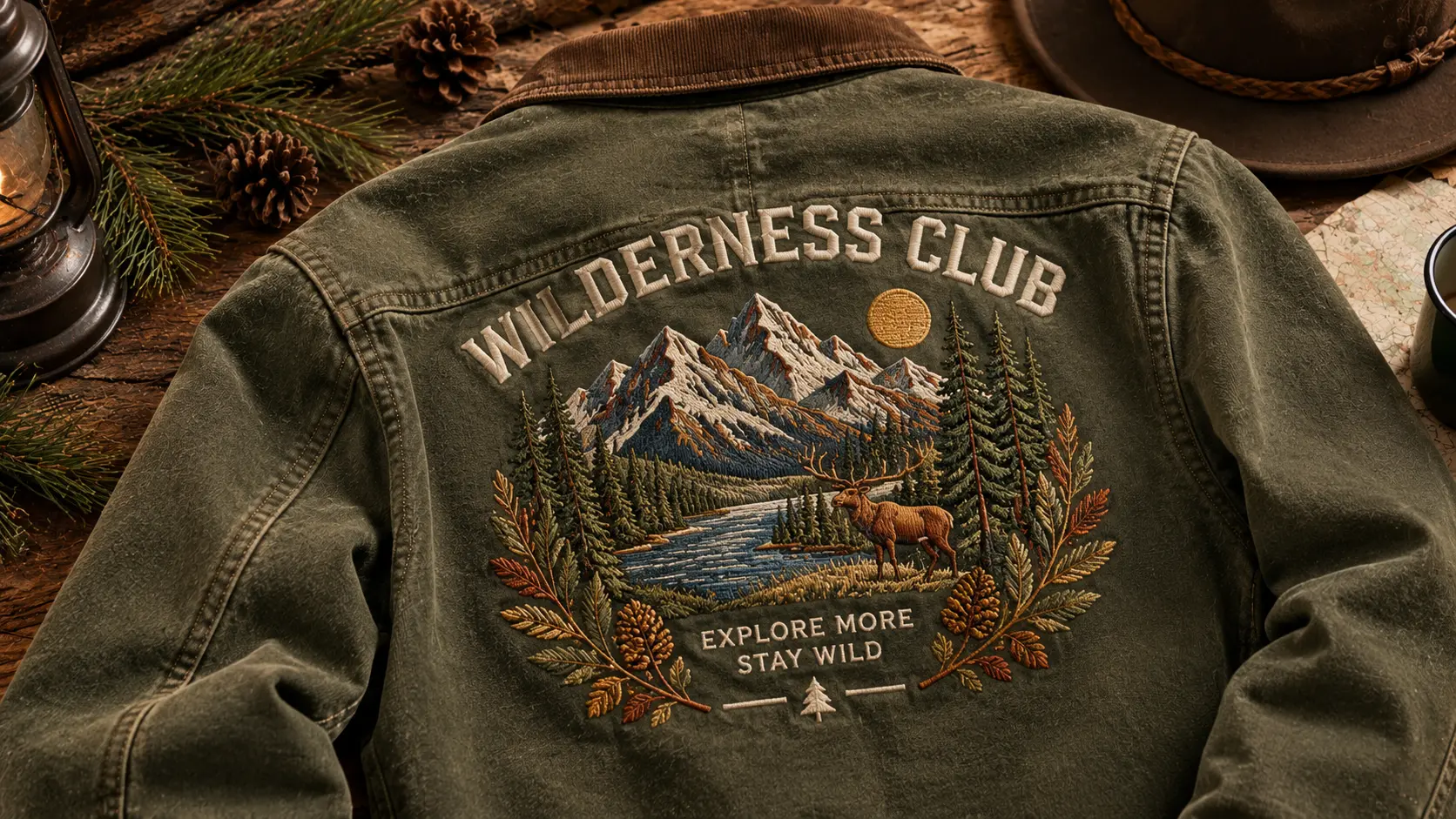
Fall 2026 designs celebrate the natural world: mountain ranges, pine trees, wildlife (bears, elk, trout, owls), botanical leaves, and rustic campfire badges.
Trending Fall 2026 Earth-Tone Palettes
Commercial shops must stock autumn thread spools early. In 2026, the dominant color palettes include:
| Color Family | Trending Thread Tones | Commercial Application |
|---|---|---|
| Forest & Foliage | Olive Drab, Hunter Green, Moss, Sage | Mountain silhouettes, foliage, corporate outdoor badges |
| Warm Earth | Rust Orange, Burnt Terracotta, Amber, Copper | Autumn leaves, campfire graphics, harvest brewery logos |
| Golden Tones | Mustard Yellow, Harvest Gold, Ochre, Wheat | Sunbursts, retro typography highlights, goldenrod florals |
| Deep Neutrals | Warm Umber, Espresso, Hickory, Dark Walnut | Animal silhouettes, tree trunks, vintage border trims |
| Atmospheric Skies | Deep Navy, Slate Blue, Storm Blue, Twilight Blue | Lake backgrounds, night sky vignettes, outerwear jackets |
| Foundational Bases | Charcoal Heather, Matte Black, Ecru, Warm Cream | Base backdrops, clean contrast lettering, subtle underlays |
Technical Digitizing Challenges for Outdoor Graphics
- 1Multi-Color Thread Layering: A detailed mountain landscape often involves 6 to 9 distinct color changes (snow caps, rock faces, timberline, foothills, lake reflection, sky gradient). Inefficient sequencing multiplies thread trims and needle rack jumps. Digitizers must consolidate colors by pathing all identical-color elements in a single sequence before commanding a color stop.
- 2Thread Shading and Blended Gradients: Thread cannot blend like ink. To simulate an autumn sunset or a fading mountain shadow, digitizers utilize stepped density blends. The base layer is sewn at 0.70mm density, and an overlapping contrasting thread is sewn at 0.85mm density with varied penetration lengths.
- 3Outerwear Substrate Resistance: Outdoor apparel frequently uses heavy 12 oz duck canvas, waxed cotton, ripstop nylon, or 300D bonded softshell outerwear.
- Increase pull compensation by 0.35mm to 0.45mm to combat dense canvas push-back.
- Switch multi-head needles from standard 75/11 ballpoints to 80/12 or 90/14 sharp needles (Groz-Beckert SAN 1 or titanium coated) to penetrate tough woven fibers without needle deflection.
- 1Stabilizer Protocols for Water-Resistant Outerwear: Water-resistant softshells can be permanently perforated by needle punctures. Keep stitch density balanced (not overly dense) and use a soft 2.5 oz cutaway stabilizer paired with silicone needle lubricant to prevent fabric puckering.
Textured and Dimensional Embroidery
In 2026, tactile engagement is paramount. When customers pick up a jacket or cap in a retail showroom, embroidery with physical height and varied textures commands an immediate 30% to 50% price premium over standard flat embroidery.
Commercial embroidery shops that master specialty textural techniques can differentiate themselves from low-cost online competitors and win high-margin custom apparel contracts.
1. 3D Puff Embroidery (Dimensional EVA Foam)
3D puff remains the ultimate technique for cap crowns, beanie cuffs, and outerwear badges.
- How it works: A high-density sheet of EVA foam (typically 2.5mm to 3.0mm thickness) is placed over the fabric. High-density satin columns cut through the foam, enclosing it completely to create an embossed, 3D relief.
- Digitizing Requirements: Standard flat satin stitches will not work. 3D puff requires:
- Stitch densities tightened to 0.16mm – 0.20mm (nearly double normal density) to completely hide the underlying foam.
- Capped ends (triangle perforations) at the tips of every letter to slice the foam cleanly inside the satin column.
- Complete elimination of tatami fill underlays beneath the puff, as underlays crush the foam prematurely.
- Explore our dedicated 3D Puff Digitizing service for production-tested cap files.
2. Chenille and Faux-Chenille Looped Embroidery
Chenille provides the warm, plush carpet-like pile traditionally seen on vintage varsity letterman jackets.
- While true moss and chain-stitch chenille requires specialized loop-stitch heads, commercial lockstitch embroidery machines can achieve stunning vintage loop textures through specialized digitizing techniques.
- By utilizing open contour fills, thick 30-weight or 12-weight matte acrylic/wool threads, and double-loop spiral fills, digitizers can create a fuzzy collegiate texture that replicates authentic campus heritage wear. Discover our Chenille Digitizing capabilities.
3. Mixed-Media Combinations
Fall 2026 is seeing massive growth in mixed-media decoration:
- Embroidery + Screen Print / DTF: Flat screen-printed background landscapes accented with high-density embroidered foreground trees, animals, or brand lettering.
- Embroidery + Laser-Etched Leatherette: Top-stitched leatherette or genuine suede patches with direct embroidery bordering the perimeter for high-end ranch wear and outdoor caps.
Production Calibration for Dimensional Stitching
| Variable | Standard Flat Embroidery | 3D Puff Embroidery | Heavy-Thread Chenille Effect |
|---|---|---|---|
| Thread Type | 40 wt Polyester / Rayon | 40 wt Polyester | 30 wt or 12 wt Matte Poly / Acrylic |
| Needle Size | 75/11 Ballpoint / Sharp | 80/12 Sharp / Titanium | 90/14 or 100/16 Topstitch |
| Satin Density | 0.38mm – 0.42mm | 0.17mm – 0.20mm (Double) | 0.45mm – 0.55mm |
| Machine Speed | 750 – 900 SPM | 550 – 650 SPM | 500 – 600 SPM |
| Tension Setup | Standard balanced | Slightly loosened top tension | Loosened top tension / enlarged eyelet |
Beanies, Caps, and Outerwear: Digitizing for Fall Blanks
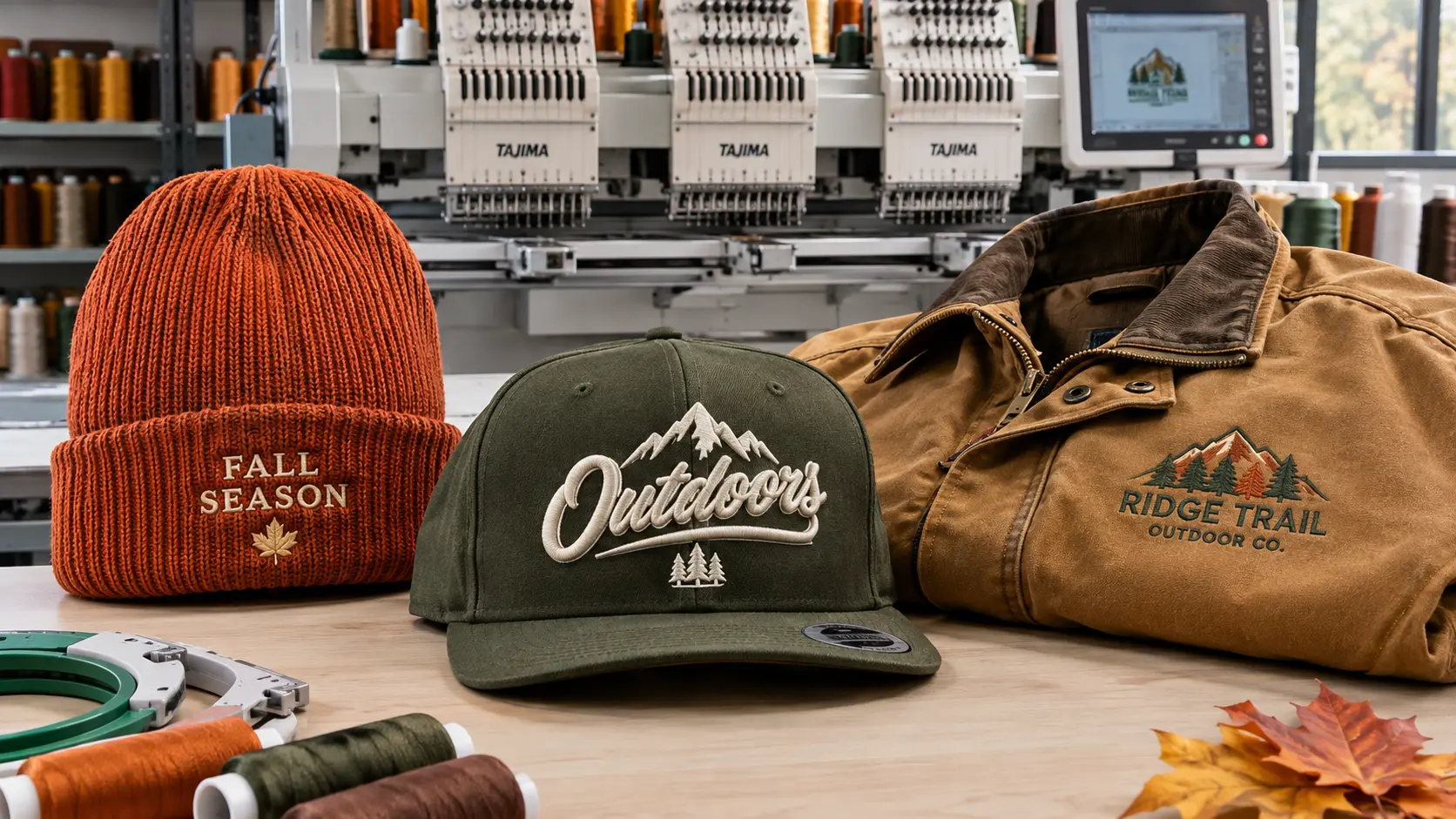
A digitized file that runs smoothly on a flat cotton polo will fail catastrophically if loaded onto a ribbed knit watch cap or a curved 6-panel trucker hat. Fall production requires substrate-specific digitizing adjustments.
1. Ribbed Knit Beanies and Watch Caps
Knit beanies are one of the highest-margin promotional and retail items sold between September and January. However, knit yarn expands, stretches, and traps fine stitches inside its deep rib grooves.
- The Problem: Satin lettering sinks into the yarn loops, causing edges to disappear and text to look ragged and unreadable.
- The Solution (Water-Soluble Topping): Always apply a layer of clear water-soluble film (Solvy) over the beanie cuff. The film acts as a temporary platform, keeping stitches resting firmly on top of the knit yarn.
- Digitizing Underlay: Program a double-lattice tatami underlay grid (knockdown stitch) beneath the entire design boundary before sewing the top satins. This compacts the fluffy ribbing, creating a solid structural floor.
- Pull Compensation: Knits compress aggressively under thread tension. Set pull compensation to at least 0.40mm to 0.50mm (15% to 20%) to prevent letters from thinning out.
2. Structured 6-Panel Trucker and Snapback Caps
Structured baseball caps remain a fall staple for sports teams, breweries, and outdoor brands.
- Center-Out & Bottom-Up Sequencing: Curved cap framing puts extreme tension on fabric. The design must stitch from the bottom sweatband upward and from the center seam outward to both sides (Center to Out, Bottom to Up). If you sew from left to right, the fabric bunches across the thick center buckram seam, deflecting needles and breaking thread.
- Navigating the Center Buckram Seam: The double-stitched center seam on 6-panel caps is rock hard. Ensure your digitizer places walking underlays across the seam before covering it with satins. Avoid placing microscopic lettering or 1mm dots directly across the center ditch.
- Height Constraints: Low-profile dad hats accommodate designs up to 2.2" high; structured snapbacks can handle up to 2.5" to 2.75" maximum. Over-stretching designs beyond the frame curvature causes needle strike collisions with the cap driver. See our Hat Digitizing technical standards.
3. Heavy Canvas Jackets, Vests, and Softshell Outerwear
Outerwear blanks (Carhartt, Dri Duck, The North Face, Port Authority) are expensive. A ruined blank can wipe out the profit of an entire small order.
- Needle Deflection Safeguards: Thick 12 oz cotton duck canvas and multi-layer softshells push needles off their vertical axis, causing skipped stitches or needle strikes against the throat plate.
- Needle Recommendations: Use 80/12 or 90/14 sharp needles (e.g., Groz-Beckert SAN 1 MR).
- Stabilizer Choice: Always pair outerwear with heavy 3.0 oz cutaway backing. Never use tearaway on jackets; the repeated mechanical stress of washing and wearing will cause tearaway to disintegrate, leading to puckered logo borders.
- Check our specialized guidelines on Shirt & Outerwear Digitizing.
Custom Patches for Fall Merch
Custom patches have exploded across the custom apparel landscape in 2026. Rather than hooping expensive, bulky jackets and beanies directly onto multi-head machines, commercial decorators increasingly opt for custom embroidered, woven, leatherette, and chenille patches.
Why Commercial Shops Prefer Patches for Fall Production
- Zero Risk to Expensive Garment Blanks: If a needle breaks or a thread birdnests on a $120 client-supplied softshell jacket, replacing the blank is costly and delays the order. Embroidering patches on continuous twill sheets carries zero garment ruin risk.
- Simplified Hooping for Difficult Blanks: Heavy canvas jackets, insulated fleece vests, small beanie cuffs, and backpacks are notoriously difficult to hoop on standard tubular frames. A pre-made patch can be heat-pressed in 15 seconds flat using a commercial cap or pocket heat press.
- Higher Customer Perceived Value: A thick patch with a merrowed border or laser-etched edge conveys an authentic military, outdoor-heritage, or high-end retail aesthetic that direct embroidery often cannot match.
- Off-Season Inventory Buffers: Shops can embroider 500 patches during slower late-summer periods and store them in bins, ready to heat-seal onto beanies and jackets as autumn reorders pour in.
The 5 Dominant Patch Formats for Fall 2026
- 1Embroidered Merrowed Patches: Traditional poly twill backing with dense 100% surface embroidery and a classic 3-thread overlock merrowed border. Supreme for workwear, service contractors, and motorcycle clubs.
- 2Woven Patches: Ultra-fine woven thread construction that captures photographic detail, tiny text down to 2mm, and razor-sharp geometric lines impossible in standard direct embroidery.
- 3Faux Leatherette & Suede Patches: Laser-engraved or debossed leatherette patches stitched onto canvas chore coats, beanies, and trucker caps for rugged outdoor elegance.
- 4Chenille Varsity Patches: Looped yarn patches backed with stiff scrim felt, perfect for high school letterman jackets and streetwear hoodies.
- 5PVC Rubber Morale Patches: Molded waterproof rubber emblems with hook-and-loop (Velcro) backings, trending strongly for tactical gear, hunting apparel, and outdoor bags.
Digitizing Workflow for Commercial Embroidered Patches
To produce custom embroidered patches in-house, digitizers follow a structured 4-step sequence:
- 1Foundation Run: Stabilization grid mapped directly onto heavy patch twill backed with heavy tearaway or Peltex stiffener.
- 2Interior Embroidery: Fills, satins, text, and fine details pathing outward from the center.
- 3Perimeter Cutline / Die Run: Reference guides for manual laser-cutting or hot-knife separation.
- 4Border Finish:
- For Merrowed Borders: Overlock edge sewn on an external Merrow machine post-cutting.
- For In-Hoop Satin Borders: Heavy 4.0mm satin border with double edge-walk underlay sealing twill edges cleanly.
- Border Density: For satin-bordered patches cut directly in the hoop, program a 4.0mm wide satin column with 0.35mm density. Include a double-edge-walk underlay to wrap the raw twill edges cleanly.
- Backing Options: Digitize files with stitch distributions calibrated for either heat-seal thermoplastic backing (for heat-press application) or hook-and-loop hook backing (for tactical and corporate gear).
- Review our dedicated Patches Digitizing technical services.
How US Embroidery Shops Can Prepare for Fall Orders
Successfully navigating the autumn rush requires disciplined operational planning. The busiest shops in North America do not wait until peak volume hits to prepare their production floors; they establish their workflows and vendor partnerships weeks in advance.
1. Audit and Stock Fall Consumables Early
Supply chains tighten every September. Ensure your shop maintains ample inventory of:
- Heavyweight 2.5 oz and 3.0 oz cutaway backing rolls
- Pre-cut 8x8 cap tearaway backings
- Water-soluble topping rolls (Solvy)
- Autumn thread palettes (olives, rusts, mustard, creams, chocolates)
- Specialty needles: 80/12 and 90/14 sharp needles for canvas and softshell jackets
- 2.5mm and 3.0mm high-density 3D EVA foam sheets
2. Digitize Artwork Before Blanks Arrive on the Dock
Do not wait for customer-supplied garments to arrive at your shop before sending artwork for digitizing. Having production-ready DST or PES files digitized and sew-out tested before blank boxes arrive ensures your multi-head machines begin stitching immediately, eliminating costly operator downtime.
3. Sew Out Seasonal Samples for Your Showroom and Social Channels
Clients rarely buy what they cannot visualize. Produce sample sew-outs showcasing:
- A 3D puff initial on a rich autumn snapback
- A vintage chain-stitch script on a pigment-dyed crewneck
- A merrowed outdoor patch on a ribbed knit beanie
- An earth-toned botanical crest on a canvas chore coat
Display these samples in your front showroom and photograph them for your website and Instagram channels to drive high-margin fall inquiries.
4. Bundle Fall Apparel Packages
Simplify ordering for school booster clubs, corporate clients, and breweries by packaging seasonal bundles:
- The Brewery Staff Pack: 12 canvas work jackets, 24 ribbed knit beanies, 48 left-chest flannel shirts.
- The School Spirit Bundle: 50 heavyweight fleece hoodies with tackle twill appliqué + 50 matching 3D puff caps.
- The Corporate Executive Gift Set: Microfleece vests featuring tonal left-chest embroidery bundled with custom debossed leatherette patch backpacks.
5. Partner With a Reliable B2B Digitizing Service for Peak Overflow
During peak fall production, internal digitizers become overwhelmed by last-minute art edits, vector cleanups, and rush turnarounds.
Partnering with an established B2B commercial digitizing service like DigitizingU provides your shop with an on-demand technical department:
- Fast 12 to 24-hour turnaround on complex multi-color files
- Expert manual pathing calibrated for zero thread breaks and optimal machine speeds
- Unlimited free revisions to ensure flawless sew-outs on challenging blanks
- Complete multi-format delivery (DST, PES, EXP, EMB, PDF run sheets)
Comparison Guide: Fall Garments, Needles, Backings & Digitizing Tolerances
| Garment Substrate | Typical Weight | Recommended Needle | Required Backing / Stabilizer | Pull Comp Offset | Key Digitizing Rule |
|---|---|---|---|---|---|
| Heavy Reverse Fleece | 10–14 oz cotton/poly | 75/11 Ballpoint | 2.5–3.0 oz Cutaway + Solvy Topping | +0.35mm (12%) | Open tatami fills; keep total stitch counts under 35k |
| Ribbed Knit Beanies | 100% Acrylic / Wool | 75/11 Ballpoint | 2.5 oz Cutaway + Solvy Topping | +0.45mm (18%) | Program dense tatami knockdown underlay grid |
| Structured 6-Panel Caps | Heavy Cotton / Twill | 75/11 or 80/12 Sharp | 3.0 oz Heavy Cap Tearaway | +0.30mm (10%) | Must sequence Center-Out and Bottom-Up |
| Canvas Chore Jackets | 10–14 oz Duck Canvas | 80/12 or 90/14 Sharp | 3.0 oz Heavy Cutaway | +0.40mm (15%) | Heavy walk underlays; strengthen needle penetration points |
| Softshell Outerwear | Polyester Stretch Woven | 75/11 or 80/12 Sharp | 2.5 oz Soft Mesh Cutaway | +0.30mm (10%) | Minimize needle penetrations to preserve waterproof membrane |
| Embroidered Patches | 200–300 GSM Poly Twill | 75/11 Sharp | Heavy Heat-Seal or Peltex Insert | +0.25mm (8%) | 4.0mm perimeter satin border with double edge-walk underlay |
Conclusion: Elevate Your Fall 2026 Production With Precision Digitizing
Fall 2026 represents an extraordinary revenue opportunity for US commercial embroidery shops and custom apparel decorators.
From vintage typography and collegiate tackle twill to earth-toned outdoor landscapes, tactile 3D puff headwear, and rugged custom patches, this season’s trends reward shops that prioritize craftsmanship, texture, and dimensional quality.
However, the creative success of every autumn trend rests entirely on the precision of the digital stitch file. A brilliant design rendered with poor pathing, inadequate pull compensation, or incorrect underlay will cause thread breaks, ruined blanks, and missed customer deadlines.
By understanding the unique mechanical properties of fall textiles and applying disciplined digitizing standards, your shop can run multi-head equipment at maximum efficiency, eliminate costly machine downtime, and deliver stunning seasonal merchandise that turns first-time fall clients into year-round accounts.
Ready to Prepare Your Fall 2026 Embroidery Files?
Don’t let digitizing bottlenecks slow down your autumn production schedule. Partner with the commercial embroidery specialists at DigitizingU:
- Expert Manual Digitizing: Engineered specifically for high-speed multi-head Tajima, Barudan, Melco, and Brother machines.
- Substrate-Specific Calibration: Precision files custom-calibrated for fleece hoodies, ribbed beanies, 6-panel caps, canvas jackets, and tackle twill.
- Fast 12–24 Hour Turnaround: Keep your machines stitching without missing a customer deadline.
- Free Unlimited Revisions: Guaranteed flawless sew-outs on every order.
Get your autumn production files queued today:
- Order Online Now to submit your fall artwork for immediate digitizing.
- Request a Free Quote for volume school spirit wear, corporate outerwear, or custom patch programs.
- Explore our dedicated Hat Digitizing, 3D Puff Digitizing, Appliqué Digitizing, and Vector Tracing services.
Need a File for Your Embroidery Machine?
Share your artwork, garment, finished size, and machine format so the team can review your digitizing request.